3/27/09

The Bear in the Line - Up


elke de gram Wim de Bruijne Cor Mantel
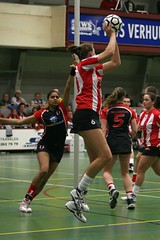
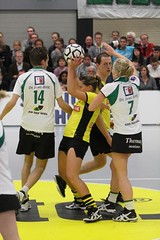
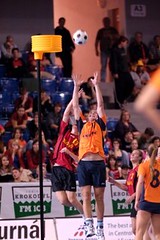
Photos by (from left to right): Elke de Gram, Wim de Bruijne and Cor Mantel.

The Bear
The Bear is a tall, strong and very athletic attacker.
He / She plays under the korf. His /her most important function is to rebound shots.
The strong Bear can give control to the continuity of the attack.
The Bear who wins frequently the rebound, gives confidence to the Tiger, Panther and Wolf when they go for a goal chance.
The Bear can develop his / her role as rebounder better and support the Tiger, Panther and Wolf in the best way if he / she is able to operate as a killer around the post.


  • The most important quality of the Bear is that he likes to win the ball after a shot. Of course he / she is really physical strong (a wide body and he /she is a good jumper) but also he / she mentally very motivated to rebound the shots.


  • The Bear can read the attack very well and his speciality is that he can read where the ball will come down after a shot.
    By reading the attack he moves around the post so that he can dominate the post zone. By blocking out his Centre or Guard he prepares the most best position for rebound the shot.
    By carefully reading the ball which comes down he / she knows how to win the ball: keeping his wide body in position or jumping up to the ball.


  • The Bear is a killer. In moments that the Guard of the Bear forgets that defence is his / her first duty, the Bear will punish that fault. The Guard or Centre (personal opponent of Bear) should not forget that control is more important than a risky undertaking for intercepting the ball. The Bear makes about 4 – 12 shot during a match and his scoring percentage near by the post is between 30 – 50 %.


  • The Bear who is a specialist rebounds 15 – 25 shots during a match. The better Bear wins about 70% -80%.
  • The Bear should cooperate with the Wolf. By his position under the korf he can give support to the Wolf that she / he can conquer the best feeding position. Sometimes the Wolf uses Bear's position to block out the Guard of the Wolf, so the Wolf can go for a goal chance. Sometimes when there is a smart cooperation, Bear and Wolf can change their roles nearby the post.
  • Very often the Bear needs the help of Wolf or Panther to come in his blocking position. The Bear gets his free lane to the post by cutting the Wolf or Panther in a feeding position. The Guard of the Bear has to follow the Bear otherwise the Bear comes in a goal position.
  • Of course the Bear can feed the Tiger and Panther from his position near by the post. The Bear is empathic for the needs of Tiger and Panther.
  • The experienced Bear is important for coaching the Tiger; Panther and the Wolf. He / she gives support and directs the other roles by communicating loudly.
  • The best Bear is all round. Sometimes he operates as a Tiger or Panther as well.
  • Mostly the Bear is a male player. There are a few female players who can operate as a strong Bear.


3/24/09

The direction of the game (see book "Korfball concepts" Bunnik 2003. ISBN 90-807931-1-6 )

Photo: Marco Spelten

mainnew widthnew
Images by Bird (CKTA)

The direction of the game
The direction of the games is initially centred from outside to inside and from inside to outside.
These are the main axis of the game.

Shooting and scoring are the most important tasks in korfball. Shooting and scoring determines the direction of the game. Shooting and scoring takes place over the main axis's. A main axis is the line , which can be drawn between the korf and the attacker. Receipt of the ball by a Tiger is a direct line while facing the korf, is an immediate threat to a Guard as he is in a shooting position.

Main axis in the game precede width axis.

A pass of the ball over a main axis from inside to outside places pressure on the defence, because the Tiger receives the ball in a position to shoot. A top Tiger is a master at requesting a ball over that main axis whilst he is still under strong defence of the Guard. When a high pass is coming over the main axis, the Tiger can withdraw from the Guard and so the Tiger can come in a shooting position. A pure shot followed like a flash.
Width axis is the entire imaginary axis that is vertical on the main axis and binds these axis together. The movement of the Tiger in such a width axis will be worthwhile and creates defensive tension when there is a move from one main axis to another. Throwing the ball over a width axis will have real tension if the Tiger recieves the ball when he is centred on the axis.

3/18/09

The Wolf in the Line - Up


Photo 1: Cor Mantel (Stuntmantel) Photo 2: Willem Kracht


Photo 3: Wim de Brijne Photo 4: Lieke Meijling

The Wolf
The Wolf is the most social role in the attack. She/ He has a good feeling for the needs of Tiger and Panther. She / he is empathic and can imagine the time and space Tiger and Panther needs for their “final” action: a goal chance.
The Wolf can support the Tiger and Panther in the best way if she / he is able to operate as a killer too.

The capabilities of the Wolf are:

* The most important quality of the Wolf is feeding the Tiger and the Panther.
The second task is to be an important link when the ball is transported all around the division so that all the roles can come in their positions. During the building up of the attack The Wolf can prepare the timing / the moment to come to the best feeding position.


* The Wolf is a killer. But she / he needs this quality to prepare her core tasks: feeding Tiger and Panther and transporting the ball. The Wolf has a very good shot from the short distance around the post. It is very special if she / he makes more that 10 shots during a match. Mostly the number of shots are between 5 – 10. The scoring percentage from the area where she starts supporting Tiger and Panther is: 16 – 30 %.

* The Wolf who fakes to come in a feeding position ( = just in front of the post and on the line Tiger _______________Post) and brings her Guard in a position that the Guard has to make a choice: going for front defence or going for back defence and give 1-1, is a false Wolf. She / he brings the Guard in a trap. The false Wolf brings her Guard to a point of definitive choice. When the Guard makes the choice for front defence, the false and smart Wolf uses her his positioning for seizing a free shot position and goal chance.

* The Wolf starts to operate on the continue of the line / axis: Tiger ___________ Post. By doing that she / he forces the personal Guard to focus on her or when the Guard does not want to do that she / he can get a free position on the back side of the Guard.

* The Wolf is able to give a goal chance to Tiger or Panther by feeding in the right way. The right way is depending on the specials of the Tiger or Panther. She / he knows when to give the pass (timing and tempo) and how to give the pass (position, direction and speed). The Wolf knows exactly the needs of Tiger and Panther to come into a goal chance.

* The action radius seems not to be large. But she / he operates during building up as a crucial link. During building up she / he can pass the ball very precisely over long distances.

* The Wolf is mentally composed and calm. She can handle the stress of the Tiger and Panther. She is socially smart.

* The Wolf is mostly a player of average height.

* Mostly The Wolf is a female player.

* The best Wolf can rotate as a Panther. A few can fill in the role of the Bear because they have an unique body height

3/10/09

The Panther in the Line-up


Jorrit Bergsma and Marijke van den Berg are very good Panthers.
Photos: Elke de Gram en Peter Besemer

The Panther

The composition of the LINE-UP demands players to take on different roles. It is not very effective to play the attack with only (or too many) Tigers. These Tigers will become rivals instead o companions. The Panther is playing in the shadow of the Tiger. We could call him a “shadow striker” or a “shadow attacker”.

The capabilities of the Panther are:
* The Panther is a killer. This players shots are very successful. The number of attempts during a match are between 10 – 18. The scoring percentage is between 20 - 30%. So The Panther makes normally less shots than the Tiger during a match but his / her output is high and important for the total score.

* The Panther is not as good as a Tiger when fighting a duel with a Guard. The Panther makes profit of the pressure of the Tiger. When the Tiger is fighting in a duel, the Tiger asks attention of the defence. In these special moments the Panther can get a free position. The Panther operates at a tempo just behind or besides the Tiger. Normally he /she starts also 6-8 meters from the post.

* The Panther is always moving. This player tries to move in an area so that his Guard cannot see the ball or give to his opponent just a glimse of the position of the ball. The Panther can wait and can choose his/her moment for to kill. He / she has the patient to select the moments to go for a free position and go for a shot. The Panther is mentally always ready but he /she is prepared but he / she can wait. The Panther is aware that he / she does not get so many possibilities to strike. But when their is a chance the Panther is totally ready, in (mental and physical) balance.

* The Panther is also a very good passer. He/she can help the Wolf to transport the ball during the building up of the attack. With the long pass he/she can change the directions of the attack and also assist the Tiger, Wolf and Bear.

* During rotation of roles in the attack the Panther can chance his/her role with the Tiger and can also take the role of the Wolf. Rotation in the attack is necessary. Tactically rotation is very surprising for the defence, the danger is coming from unexpected sides. In attacks where players don’t rotate the roles, the structure of the attack is easily to understand for the defence.

Feed back

Dear Readers,
There are people from 43 countries who open my web log. I am very happy with that. May be you have any questions about korfball. You can write to ben.crum@knkv.nl.
I will try to anwer you.
Ben Crum

3/3/09

The Tiger in the Line- Up


Photo: Cor Mantel (Stuntmantel)


Photos: Elke de Gram

The Tiger

Before every match the coach has to compose a line up.
The core role in the line up of the attack is the role of the TIGER.
The capabilities of a TIGER are:

* The Tiger is a killer. In every match he/she scores. The top Tigers in the Dutch competition score about 4 - 6 goals in every match. (when free passes and penalties are included they score 7 – 8 goals in a match) Their average scoring percentage is 20 - 30 % (without the free pass and penalties). The Tiger does about 20 -30 shot attempts in a match. The goals by the Tigers made by free pass and penalties are 30% of his/her total scores.

* Mostly the Tigers are male players. In the Dutch competition there is also one excellent female Tiger who scores between 20% - 30 %. In 14 matches she scored 74 goals (also 20 goals by penalties and free passes included). It is a pity that there are so few female Tigers who can make structural decisive difference in matches.

* The distance shot of the Tiger is excellent. She/He scores are over 30% from a totally free position. Under high pressure of a good Guard the scoring can go down. But the excellent quality of the distance shot gives way for other scoring options like running in and all kinds of V-shots. The Tiger can play and vary between the distance shot, running-in and V-shots.

* The shot of the Tiger will be released high. This makes it difficult for the Guard to block the shot. In the Dutch competition top Tigers are mostly tall players ( 1.90 – 2.00 meters).

* The Tiger can 'finish' at every time or moment during the match. A Tiger can handle the pressure of having the obligation to score. This means that he/she can open the match and score at crucial moments when there is a maximum of pressure. Then the real Tiger can take the responsibility and go for the chance created by scoring. The Tiger has a good balance between what is demanded (by coach, other players or the public) and his/her confidence in what he/she will perform. The top Tiger can perform under high pressure. This player naturally has a positive perception of his/her capabilities.

* A Tiger is totally focused to on scoring. During a match he/she makes use of more than 20 scoring attempts.

* A Tiger can duel with every Guard and can make very effectively profit of the weak sides of the Guard. Duels between Tiger and Guard should produce free positions which can be used for scoring attempts. Such a fight between Tiger and Guard is characterized by high tempo and a lot of changes of tempi and directions. The Tiger is fast and always ready to change directions in a high tempo. When the Tiger comes into free position, he/she is able to collect himself/ herself and to come in the right balance for a successful shot.

* A Tiger likes the Wolf as assist. The Wolf is the best supporter for the Tiger, because this player knows the position, the moment and the direction the Tiger needs assistance in. The Tiger is fed by the Wolf. The Wolf should understand the actions of the Tiger. The Wolf can value these actions and give the effective and efficient cooperation and communication. Mostly the Tiger is not focussed on chances of the Panther, Wolf and Bear. The Tiger will not naturally play a double pass so that the Panther can finish the attack.

* The top Tiger, in free position about 3-6 meters from the post will not hesitate to go for the chance, even when there is no Bear for rebounding the shot. The Tiger sends out confidence in his/her capabilities.